

SEO has never been a static discipline. From the days of stuffing keywords into invisible white text to today’s scramble to get cited inside AI-generated summaries, it’s gone through more reinventions than most marketing channels combined. This blog covers the full arc: every major era, every turning point, and then gets into the part that actually matters right now: what you need to do differently to stay visible in Google’s AI Mode, SGE, and AI Overviews in 2026. The data used here comes from verified industry sources. No filler, no vague advice.
Table of Contents
Your Traffic Isn’t What It Used to Be: Here’s Why
Pull up your Google Search Console and look at the last 18 months. If you’re seeing more impressions but fewer clicks, or flat traffic despite rankings that haven’t moved, you’re not alone, and you’re not imagining things.
Search results look different now. There’s an AI-generated block sitting above everything else on the page. Below that, related follow-ups, contextual suggestions, maybe a few links. By the time a user gets to the traditional blue links, plenty of them have already gotten what they needed. They didn’t click anywhere. They just… left.
This is what the data looks like: SparkToro’s Q4 2025 clickstream study found 56% of Google desktop searches end without a click to any external site. For queries triggering AI Overviews specifically, Semrush puts that zero-click rate at 80–83%. Google’s AI Mode pushes it to 93%.
Sit with that for a second.
Here’s where it gets more nuanced, though; organic traffic isn’t gone. It’s redistributed. Brands that land inside AI-generated answers are getting clicks. High-intent clicks. People who already half-trust them before they even arrive. AI referral traffic is growing even as traditional click-through rates fall. The opportunity isn’t dead. The rules changed.
Part 1: A Brief History of SEO; Era by Era
The 1990s: Pure Chaos
The story of SEO doesn’t start in a boardroom. It starts in the mess of the early internet, where webmasters were doing whatever it took to get their pages seen.
Search engines back then, AltaVista, Lycos, Yahoo Directory, worked on almost laughably simple logic. More mentions of a keyword meant you probably deserved to rank. There were no quality checks. No penalties. Tactics like white-text-on-white-background keyword repetition were not only common; they worked. Nobody talked about user intent because nobody had thought to build a system sophisticated enough to care about it.
In 1997, “search engine optimization” became an actual phrase. Practitioners like Bruce Clay and John Audette started putting structure around what had been, until then, a collection of tricks. The discipline had a name. Now it could grow.
The 2000s: Google Changes the Rules
Google’s PageRank algorithm introduced something that, in hindsight, feels obvious: pages that other trustworthy pages link to are probably more valuable. Suddenly, links mattered; not just keywords.
Predictably, the moment links mattered, people started buying and manufacturing them. The local SEO category started taking shape during this period, too, with Google using location and search history to personalize results. The Google Toolbar gave SEOs a way to see their PageRank score. Things were exciting. Also, things were getting messy.
2010–2016: Panda, Penguin, and Actually Having to Try
If the 2000s were the Wild West, Google’s 2011 Panda update was the sheriff showing up.
Panda targeted content farms. Sites built on hundreds of thin, low-quality articles designed to rank but not to inform took major hits. EzineArticles.com, one of the biggest casualties, had to gut its content standards and start over. Content quality had consequences for the first time.
Penguin arrived in 2012 and went after the link schemes that had been growing unchecked for years. Buying links, participating in link networks, and aggressive exact-match anchor text all became a liability overnight.
Then came Hummingbird in 2013. This one was different. Google wasn’t just matching keywords anymore; it was starting to understand what a query actually meant. Semantic search. Natural language. The seeds of everything that’s happened since were planted right there.
Mobilegeddon in 2015 pushed mobile-friendliness as a ranking factor. If your site didn’t work well on a phone, your rankings were going to reflect that. Mobile-first indexing was on its way.
2018–2023: E-A-T, BERT, and Writing for Humans
Google’s Quality Rater Guidelines introduced E-A-T in 2018: Expertise, Authoritativeness, Trustworthiness. At first, it was primarily aimed at health and finance content. Over time, it spread everywhere. Eventually, it became E-E-A-T, with Experience added to the mix.
BERT launched in 2019. Deep natural language processing. For the first time, Google could actually parse the context and nuance of a sentence, not just the keywords in it. A search for “can you get medicine for someone at the pharmacy” could now be understood as a question about picking up a prescription, not just a query containing the words “medicine” and “pharmacy.”
The 2022 Helpful Content Update drew a hard line. Content written for search engines, not for readers, would be downgraded. The message was blunt, and Google meant it.
Part 2: Era 5 (2024–2025); When AI Rewrote the Playbook
This is the section that actually determines whether your content makes it through the next few years intact.
SGE, AI Overviews, and How This Started
In May 2023, Google unveiled the Search Generative Experience (SGE) at Google I/O, an experimental AI layer that generated direct answers to search queries by synthesizing information from multiple sources. Early access was opt-in through Search Labs.
By March 2024, it was showing up in live search results. Then, in May 2024, Google rebranded it as AI Overviews and started a broader US rollout. By late 2025, AI Overviews were reaching over 1 billion people every month across 200+ countries and 40+ languages.
This wasn’t an algorithm tweak. This was a structural change to what a search result actually is.
Google AI Mode: The Next Layer
At Google I/O 2025, Google announced AI Mode, a full conversational search experience, separate from standard results, powered by Gemini 2.5. Less like a search result, more like a research assistant that synthesizes sources and holds a conversation.
AI Mode rolled out to 180+ countries by August 2025. And where AI Overviews see around 93% of sessions ending without users clicking elsewhere, AI Mode sees 93% of sessions not leaving Google at all. Users aren’t bouncing. They’re staying inside Google’s ecosystem, getting what they need without visiting your site.
The Zero-Click Reality, In Actual Numbers
BrightEdge tracked queries between May 2024 and September 2025. AI Overviews were appearing for 44.4% of queries by the end of that period, up from 26.6% at the start. Glenn Gabe, an SEO researcher who watches this closely, documented a 57% drop in queries showing featured snippets between September 2024 and March 2025. AI Overviews have absorbed much of what featured snippets used to do.
Publisher traffic took real damage. Business Insider lost 55% of its organic traffic over 2024–2025. Forbes, 50%. HuffPost, 50%. Digital Content Next found a median 10% year-over-year traffic decline across 19 major publishers in H1 2025, with non-news sites down 14%.
That’s the bad news. The counterweight: AI referral traffic is growing. Brands getting cited inside AI answers are pulling in high-intent visitors who already have some trust built up before they arrive. Being cited is becoming worth more than ranking at position 3.
The Algorithm Crackdown on AI-Generated Junk
Google didn’t just roll out AI search features; it also spent 2024 and 2025 dismantling the low-quality content ecosystem that AI writing tools had made easy to build at scale.
The March 2024 Core Update targeted scaled content abuse (mass-produced AI content created purely for rankings), expired domain abuse (buying old domains to leverage inherited authority for thin content), and what the industry calls parasite SEO. Manual enforcement started in May 2024. Forbes Advisor watched its top-3 keyword rankings fall from approximately 10,400 to 3,279 within about a month.
The December 2025 Core Update was worse. Commentators called it “the most brutal of the year.” Affiliate sites saw a 71% impact rate. Health content, 67%. E-commerce, 52%.
The pattern here is not subtle. Google is methodically removing content that exists to rank, not to help.
Other AI Search Platforms Are Actually Growing
ChatGPT Search launched on October 31, 2024. By October 2025, ChatGPT had 800 million weekly users, with information-seeking overtaking content creation as the primary use case. Anthropic added web search to Claude on March 21, 2025. Perplexity AI grew from a $520 million valuation in January 2024 to $20 billion by September 2025, processing 780 million monthly queries with 45 million active users.
Optimizing for Google alone is no longer the full picture. Visibility across AI-generated answers, across multiple platforms, is where the game has moved.
Part 3: How to Actually Rank in Google AI Overviews and AI Mode
Start With What Google Actually Says
Google’s own Search Central documentation is worth reading directly. The guidance is straightforward: there are no special technical requirements to appear in AI Overviews or AI Mode beyond what’s required for standard search. Your page needs to be indexed, eligible to show a snippet, and compliant with Search policies.
No secret schema. No AI-specific sitemap. No magical new markup. Just standard SEO, done well.
E-E-A-T Has Stopped Being Optional
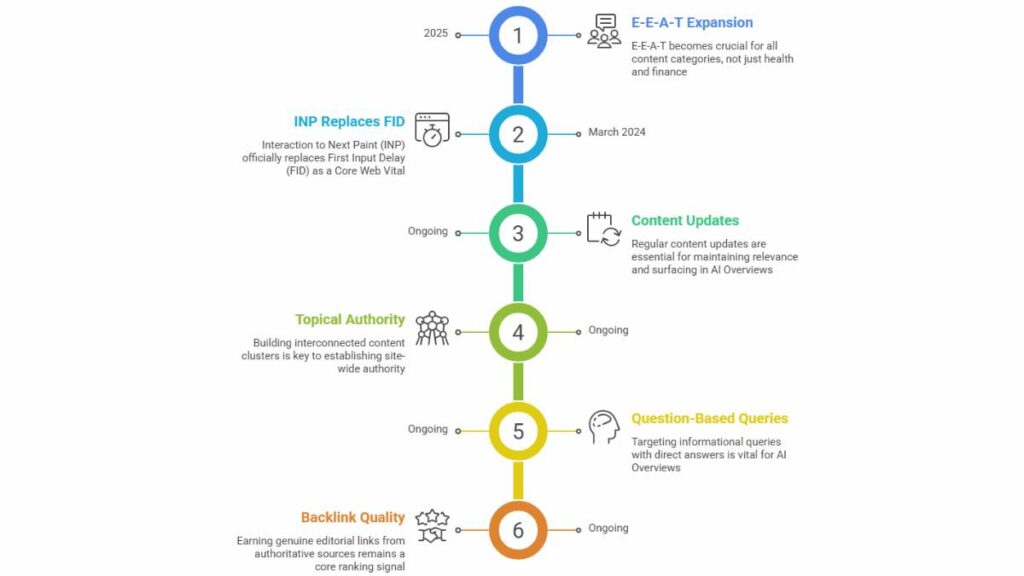
E-E-A-T: Experience, Expertise, Authoritativeness, Trustworthiness, used to feel like a box to check for health and finance publishers. By 2025, it had expanded to cover product reviews, tutorials, buying guides, and basically any content category Google’s systems touch.
Demonstrating Experience means attributing content to real people with verifiable credentials. Author bios with actual backgrounds. Case studies showing what happened in a real business context. Original data: your own surveys, your own test results; that competitors genuinely cannot replicate.
Authoritativeness comes from earning links and mentions from trusted sources in your niche. Being cited by industry publications. Building a body of interconnected content around a specific topic area, rather than scattering one-off articles across random subjects.
Trustworthiness looks like what it sounds like: a secure site, transparent editorial standards, and accurate and up-to-date content. The signals that tell both readers and Google’s systems that this is a site run by real people who stand behind what they publish.

Enroll Now: Advanced Digital Marketing Course
Format Your Content So AI Can Use It
This is one of the most concrete changes available right now. AI Overviews are designed to synthesize content from multiple sources and surface direct answers. If your answer is buried three paragraphs in, behind an introduction and a historical overview, the AI system will pull from someone else’s page that leads with it.
The structure that works:
Answer first. Every key section should open with a 1–2 sentence direct response to the question that section addresses. Then the supporting context. Not the other way around.
Clear header hierarchy. H2s and H3s act as navigational anchors. Each one should be specific enough to function as a standalone question or answer; not a vague label like “Key Considerations.”
Bullet points, numbered lists, comparison tables. Information that would otherwise get lost in dense paragraphs is much easier for AI systems to extract and surface when it’s structured. Not every section needs this treatment, but high-information sections benefit from it.
FAQ sections with FAQ schema markup. Pages with FAQ schema are, per available research, 60% more likely to be featured in AI Overviews than equivalent pages without it. The schema helps Google understand that a section is question-answer formatted, something AI systems are specifically looking to pull from.
Keep content current. Stale pages surface less. Regular updates; new stats, corrected information, added examples; signal ongoing relevance.
Build Topical Authority, Not Just Individual Pages
One of the clearest patterns in how AI Overviews select sources is a preference for sites with genuine depth on a subject, not sites that happen to have one strong article on it.
The practical answer: content clusters. A pillar page covering the main topic, connected to a set of cluster pages that go deep on specific subtopics. All of it is interlinked deliberately. This architecture tells Google that the site isn’t just accidentally relevant; it’s an actual authority.
If the subject is digital marketing, that means a full interconnected library across SEO, content strategy, technical optimization, AI search, and analytics. Not a standalone “what is SEO” article sitting by itself.
Technical SEO: Still the Foundation
No AI search strategy works on a site with technical debt. The fundamentals are still the floor:
Pages need to load fast. Core Web Vitals, including INP (Interaction to Next Paint), which officially replaced First Input Delay in March 2024, are active ranking signals. Slow pages don’t just frustrate users; they signal a lower-quality experience to Google’s systems.
Crawlability needs to be clean. Check robots.txt. Verify that CDN or hosting configurations aren’t blocking Googlebot. There’s no point investing in content quality if Google can’t access the pages.
Mobile-first indexing is the default. Poor mobile experience means diminished rankings, full stop.
Internal linking helps AI systems understand the relationships between pages and the broader context of what a site covers. It’s not just navigation; it’s an authority signal.
Target Questions, Not Just Keywords
AI Overviews appear most consistently for informational queries; “how to,” “what is,” “why does,” and similar structures. Question-based queries trigger them at extremely high rates. That doesn’t mean abandoning keyword research; it means layering intent analysis on top of it.
For every target keyword: what is the person actually trying to accomplish? What question are they really asking when they type that phrase? Then structure the content to answer it directly. Conversational, long-tail queries aligned to natural speech are also valuable for voice search optimization, which feeds into the same AI-driven ecosystem.
Backlinks Still Matter
This keeps coming up because it keeps being true. Backlinks remain a core signal in Google’s ranking systems, and those same systems power AI Overviews. Quality inbound links from authoritative sources signal that content is trusted. Trusted content is what AI models want to cite.
The strategy has shifted. Volume-based link building and link networks are liabilities. Earning genuine editorial links through original research, expert commentary, and content that other credible sites actually want to reference is what works. Brand mentions and citations across third-party platforms, industry publications, specialist forums, and review sites build the kind of ambient authority that AI systems pick up on.
The shift from volume-based tactics to quality editorial links, answer-first content, and ongoing updates means SEO is now an operating expense, not a one-off project. If you’re planning 2026 budgets and need a pragmatic breakdown of monthly SEO packages—what’s typically included (technical fixes, content production, digital PR/link earning), price ranges, and when a one-time audit makes sense—learn more about comparing retainer vs one-time options.
Part 4: GEO, AEO, and Understanding the New Optimization Landscape
What GEO Actually Is
Generative Engine Optimization; the term was formalized by researchers from Princeton University, Georgia Tech, the Allen Institute for AI, and IIT Delhi. GEO is the practice of optimizing content to be cited in AI-generated outputs, not just to rank in traditional search results.
The core metric shifts. It’s not “where do I rank?” anymore; it’s “how often does AI cite me?” Content strategies built around this question look different: more factual rigor, cleaner sourcing, structure designed to be extractable, and authority signals that AI models weigh heavily.
What AEO Is
Answer Engine Optimization focuses on direct-answer interfaces; voice assistants, chatbots, and AI search experiences that give a single answer rather than a list of links. It overlaps significantly with GEO but has specific applications for voice search (conversational query targeting, “near me” optimization) and structured data like FAQ and HowTo schema.
How All Three Work Together
GEO and AEO don’t replace SEO. They extend it. Google Search Central is explicit: traditional SEO excellence is the foundation of AI Overview success. The brands winning in AI search are the ones that have solid traditional SEO fundamentals and have layered AI-specific content strategies on top.
The realistic framing for 2026: content needs to perform across multiple surfaces; traditional search results, Google AI Overviews, AI Mode, ChatGPT Search, Perplexity, Claude. The quality and authority signals that help with one increasingly help across all of them.
Part 5: Measuring SEO Success When the Old Metrics Aren’t Enough
Traditional keyword rankings tell only part of the story now.
In Google Search Console: AI Overviews and AI Mode traffic is included in the Performance report under “Web” search type. It isn’t separately filterable; you can’t isolate AI Overview clicks from standard organic clicks. Third-party tools, including SEMrush, Ahrefs, and specialized AI visibility platforms, offer more granular tracking.
Metrics worth tracking alongside traditional rankings:
Citation frequency: how often does your content appear as a source in AI Overviews across your target queries? This requires third-party tooling or manual spot-checking, but it’s increasingly the number that matters.
Branded search volume growth; when AI cites a site, branded searches often increase downstream. It’s a useful proxy signal for AI citation impact, even if it’s indirect.
AI referral traffic; direct visits from AI-generated answer surfaces. Track it separately where tooling allows.
Content freshness; how recently were key pages updated? This shows up in performance.
Part 6: Is SEO Dead? No. But Some Versions of It Are.
This question resurfaces every couple of years. It surfaced when Panda hit content farms. It surfaced when voice search grew. It’s surfacing again now.
The global SEO market was valued at $86.8 billion in 2025 and is projected to reach $127–155 billion by 2030, growing at a 12–13% CAGR. Markets don’t grow like that for disciplines that are dying.
What is dying, and quickly, is SEO built on shortcuts. Scaled AI-generated content with no editorial oversight. Thin pages built for rankings. Link schemes. Parasite SEO on expired domains. Google spent 2024 and 2025 systematically dismantling these tactics, and the December 2025 Core Update made clear they’re not coming back.
The brands that lost 40–55% of organic traffic through those algorithm cycles had things in common: over-reliance on AI-generated content at scale, weak E-E-A-T signals, and content strategies designed for rankings rather than readers.
The brands that held or grew visibility during the same period invested in genuine expertise, maintained editorial quality, and adapted to AI search rather than trying to outmaneuver it.
Conclusion
The evolution of SEO is still underway. From keyword stuffing in the 1990s to AI-generated search answers in 2026, every era has sorted brands into two groups: the ones that adapted and the ones that didn’t.
The shift to AI Mode and AI Overviews is the biggest structural change Google has ever made to its search experience. And yet, the underlying principle hasn’t moved. Make content that genuinely serves the person searching for it. Answer their question. Make it easy to find, easy to read, and built on real expertise.
The brands winning in AI search aren’t using tricks. They’re demonstrating real knowledge, structuring content so AI can actually extract and cite it, building topical authority across interconnected content, and keeping the technical health of their sites clean. SEO hasn’t gotten easier. But the path forward is clearer than it’s been in a long time. Do the fundamentals well, and the algorithms, AI-powered or not, will find you.
FAQs:
1. What is the evolution of SEO in simple terms?
SEO has changed dramatically from its origins in the mid-1990s, when basic keyword repetition was enough to rank. Each decade brought major shifts: PageRank and links in the 2000s, content quality signals in the 2010s, natural language understanding in the late 2010s, and AI-generated search answers from 2023 onward. The discipline is now a sophisticated mix of content strategy, technical optimization, authority building, and AI-specific formatting.
2. What is Google AI Mode, and how does it differ from regular search?
AI Mode is a conversational, Gemini 2.5-powered search experience Google announced at I/O 2025. Unlike standard search, which shows a list of links, AI Mode generates synthesized answers and supports multi-turn conversation. It rolled out to 180+ countries by August 2025. Around 93% of AI Mode sessions end without users navigating away from Google.
3. What is SGE; is it the same as AI Overviews?
SGE (Search Generative Experience) was Google’s experimental name for its AI-powered search feature when it launched in May 2023. In May 2024, Google officially rebranded it as AI Overviews and began a broader rollout. Same underlying technology; AI Overviews is the current name.
4. How do I get my content featured in Google AI Overviews?
Standard SEO best practices apply. Make sure pages are indexed and eligible to show snippets. Write helpful, people-first content. Build E-E-A-T signals. Use structured formatting; H2/H3 headers, bullet points, and FAQ sections with schema markup. Keep content updated. Earn quality backlinks. Google’s own documentation confirms that no additional technical requirements exist beyond standard SEO.
5. What is E-E-A-T, and why does it matter for AI search?
E-E-A-T stands for Experience, Expertise, Authoritativeness, and Trustworthiness; Google’s framework for evaluating content credibility. Originally focused on health and finance content, it expanded to cover virtually every content type by 2025. Strong E-E-A-T signals are foundational to appearing in AI Overviews and AI Mode.
6. What is zero-click search, and how does it affect SEO strategy?
Zero-click searches are queries where users find their answer on the search results page without clicking through to any website. SparkToro’s Q4 2025 study found 56% of desktop Google searches are now zero-click. The practical response is adapting the strategy to target AI citation, build brand authority, and track branded search growth as a downstream signal rather than abandoning SEO altogether.
7. What is GEO (Generative Engine Optimization)?
GEO is the practice of optimizing content to be cited in AI-generated answers, not just to rank in traditional results. The term was formalized by researchers from Princeton University, Georgia Tech, the Allen Institute for AI, and IIT Delhi. The key metric shifts from keyword ranking to citation frequency in AI-generated outputs across platforms.
8. What is AEO (Answer Engine Optimization)?
AEO; Answer Engine Optimization, is the practice of optimizing for direct-answer interfaces like voice assistants, chatbots, and AI-powered search features. It focuses on conversational query targeting, FAQ, and HowTo schema markup, and content structured for single-answer extraction. It works alongside traditional SEO, not instead of it.
9. Does traditional SEO still matter with AI Overviews?
Yes. Google Search Central explicitly states that traditional SEO excellence is the foundation of AI Overview visibility. Pages appearing in AI Overviews must first be properly indexed, crawlable, and optimized according to standard best practices. There are no AI-specific technical requirements; strong foundational SEO is the prerequisite for everything else.
10. How do AI Overviews decide which sources to cite?
AI Overviews draw from Google’s core ranking systems; the same signals governing traditional search: content quality, E-E-A-T, backlink authority, topical relevance, and page experience. Being in top-ranking positions for a query significantly increases the likelihood of appearing as a cited source in its AI Overview.
11. What happened to featured snippets with the rise of AI Overviews?
Featured snippets have declined sharply. Glenn Gabe documented a 57% drop in queries showing featured snippets between September 2024 and March 2025. Keywords Everywhere data showed snippet SERP visibility falling 64% between January and June 2025. AI Overviews have effectively replaced snippets for complex, multi-part queries. Simple factual lookups still generate snippets in some cases.
12. How did the March 2024 Core Update change SEO?
It targeted three categories of manipulation: scaled content abuse (mass AI-produced content for rankings), expired domain abuse (repurposing old domains with thin content), and parasite SEO. Google aimed to reduce unhelpful content in results by 40–45%. Manual enforcement began in May 2024. Forbes Advisor’s top-3 keyword rankings dropped from around 10,400 to 3,279 within weeks.
13. What is topical authority, and why does it matter for AI search?
Topical authority is the depth and breadth of expertise a site demonstrates on a specific subject area. Rather than isolated articles, it’s built through interconnected content clusters; a pillar page plus supporting articles, that signal comprehensive subject-matter expertise. AI Overviews and AI Mode consistently favor topically authoritative sources over sites with single strong articles.
14. How do I track whether my content appears in AI Overviews?
AI Overviews traffic is included in Google Search Console’s Performance report under “Web” search type, but isn’t filterable separately from standard organic traffic. Third-party tools, including SEMrush, Ahrefs, and specialized AI visibility platforms, offer more granular tracking. Monitoring branded search volume growth also works as a useful proxy signal for AI citation impact.
15. Is AI-generated content penalized by Google?
Not automatically. Google rewards helpful, high-quality content regardless of production method. What’s penalized is scaled content abuse, using AI to generate large volumes of generic content purely for ranking manipulation. The December 2025 Core Update hit these sites hard. Human editorial oversight and original insight remain essential components of any AI-assisted content workflow.
16. What role do backlinks play in AI Mode and AI Overview rankings?
Backlinks remain a core ranking signal in Google’s systems, which also power AI Overviews. High-quality editorial links from authoritative sources signal trustworthiness, a critical E-E-A-T component. The strategy has shifted toward quality over volume: earning genuine links through original research, expert content, and resources that other credible sites actually want to reference.
17. How has the rise of ChatGPT and Perplexity changed SEO?
These platforms have created a multi-engine optimization reality. ChatGPT Search had 800 million weekly users by October 2025. Perplexity reached $20 billion in valuation and processes 780 million monthly queries. SEO in 2026 means building visibility across Google, ChatGPT, Perplexity, Claude, and other AI search interfaces, not just traditional Google rankings.
18. What content formats perform best for AI Overview inclusion?
Structured content consistently outperforms dense prose. Clear H2/H3 header hierarchies, bullet points, numbered lists, comparison tables, and FAQ sections all perform well. Opening key sections with direct 1–2 sentence answers before supporting detail matters. Pages with FAQ schema markup are approximately 60% more likely to be featured in AI Overviews than comparable pages without structured data.
19. Is SEO still worth investing in during 2026?
The data is clear. The global SEO market was valued at $86.8 billion in 2025 and is projected to reach $127–155 billion by 2030 at a 12–13% CAGR. The tactics have evolved, but the strategic value of organic search visibility, especially through AI citation, is higher than it’s been for a long time for brands willing to invest in genuine quality and authority.
20. What are the most important SEO actions to take right now for AI search?
Six things: Audit and strengthen E-E-A-T signals, starting with author credentials. Restructure top-performing pages with answer-first formatting and FAQ sections. Implement FAQ and HowTo schema markup. Build topical content clusters around core subject areas. Ensure technical SEO is clean; fast load times, proper crawlability, solid mobile experience. Earn quality editorial backlinks from trusted sources in the niche.